My only contribution to this European trip was suggesting the idea. Once the seed was planted in everyone's heads, Kristina did all the planning and reservation-making among other things. One of those "other things" was providing the three of us a personal tour of the Vatican City. (Thanks sis!) Amadeo was a lovey, ex-professor, Italian gentleman who was our personal guide of the Vatican and he was outstanding. Now, I may be biased because I was born and raised Catholic. However, I think anyone who appreciates history or any form of spirituality would definitely enjoy it just as much. Below is some of the art we saw and some of the history we learned!

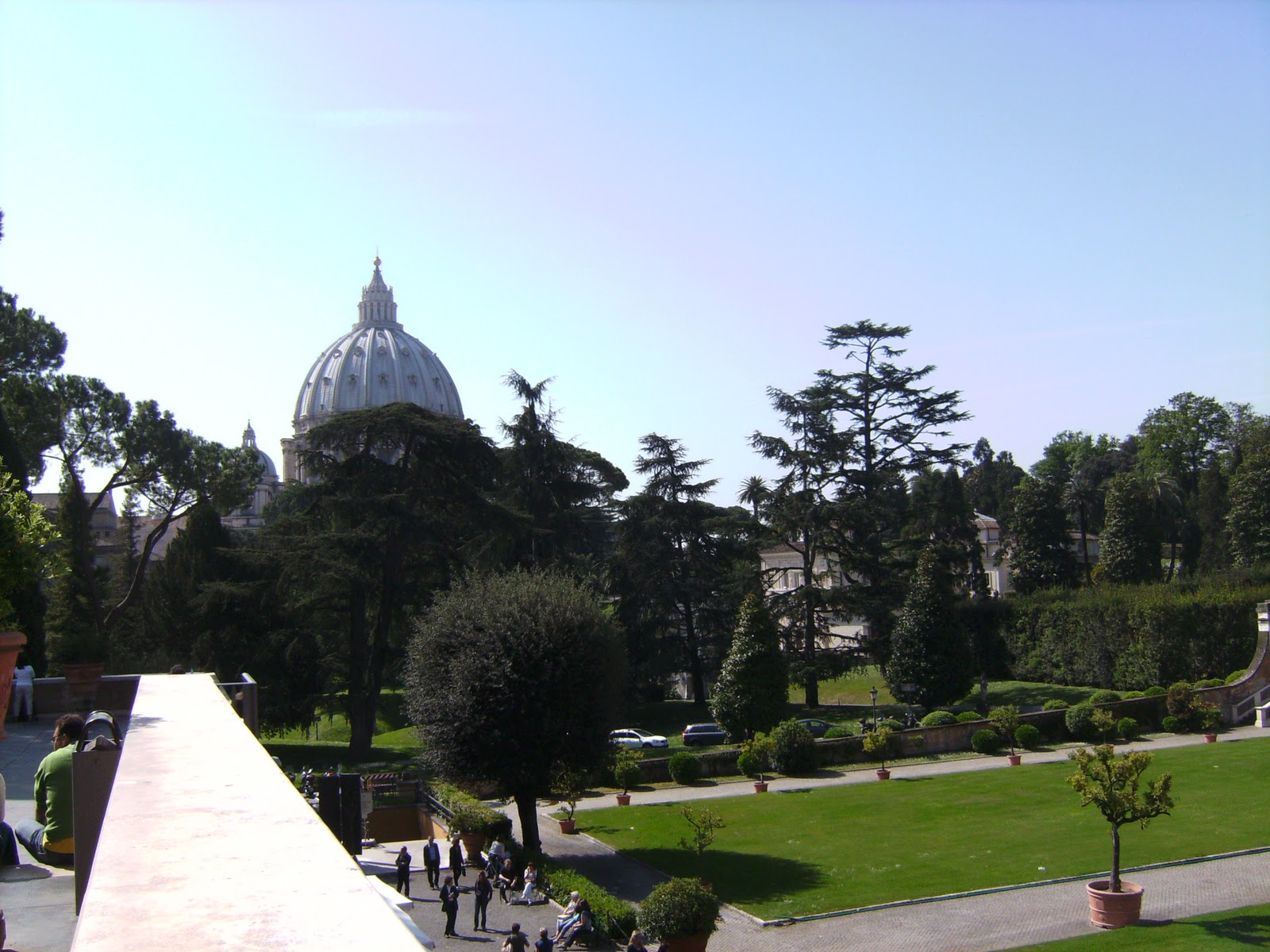
The Vatican Garden was one of the first Italian Renaissance gardens in Rome. You can see St. Peter’s Chapel from here, which is the tallest dome in the world.


The Belvedere Courtyard has undergone many transitions throughout its time in the Vatican Museum. At one point it was the location of Swiss Guard training. On the right side, the men had their sleeping bunks. On the left side, the horses had their stables. The bronze pine cone at the head of the courtyard gives the upper terrace its own name: Cortile Della Pigna. It dates back to the 1st century AD and originally sat in the Pantheon before relocating to the Vatican. The pine cone is a Roman symbol while the lions and peacocks on either side are Egyptian symbols. The ball in the center of the courtyard, "Sphere Within Sphere," is a piece of artwork that has multiple versions around the world in NYC, Washington DC, Indianapolis, Berkeley, San Fransisco, and Dublin. The inner sphere represents earth and the outer sphere represents Christianity.


Augustus of Prima Porta is a statue of Augustus Caesar. The statue's inclusion of Cupid riding a dolphin (small, at the base) reveals his supposed mythical ancestry from the goddess Venus (Cupid's mother) by way of his adopted father, Julius Caesar.

Aesculapius is the Greek god of medicine and healing; his symbol is the physician's staff with an Asclepian snake wrapped around it. Many organizations use the Caduceus-- a winged staff with intertwined serpents around it-- as their medical symbol; this actually represents the magic wand of the Greek messenger god, Hermes, and it has no medical relevance!

Laocoon And His Sons is a statue made around 50 BC. There are many legends of why he and his sons perished under the strength of these two great sea snakes. The version that Amadeo told us was this: Laocoon was a priest of the Greek god, Apollo, and he tried to warn the Trojans that the Greeks' wooden horse was a trick. Since the prophecies had destined the Greeks to win this war, he was punished for threatening fate.

Colossus of the Nile was created in the first century AD. The crocodiles and sphinxes are part of the river god's representation while the grapes and multiple children represent the life and prosperity of the Nile River.

The sculptures below, in order: Emperor Commodus (aka the bad guy in "Gladiator.") Eros (or Cupid) circa 330 BC. Hercules with a lion skin and gnarled club. Shelf of bearded men (I love beards) that are most likely Greek and/or Roman philosophers. (Non-philosopher Romans kept themselves cleanly shaved.) Modern-looking Spartan woman circa 460 BC. Dionysus, Greek god of wine!


Amadeo tried to show the difference of styles between Greek and Roman statues. He used these two examples: the first is a Greek sculpture that is strong and masculine, but still has some feminine beauty. The second is a Roman sculpture where their beauty is basically just brute force and muscle.


St. Peter's Square was designed by Bernini and built between 1656 and 1667. The huge, elliptical piazza is outlined by a monumental colonnade oriented like open arms; symbolically it welcomes the world into the Catholic Church. The obelisk located in the center of the square dates back to the 13th century BC Egypt and was brought to Rome in the 1st century AD. (Like most obelisks in Rome, it was confiscated from Egypt!) At the head of the square is St. Peter's Basilica. The grand facade is topped with 13 statues of some of the Twelve Apostles (not Judas) and saints as well as Jesus in the center. The dome of the basilica was designed by Michelangelo.


The Papal Apartments are a collection of private and state apartments for the Pope: offices, studies, bedrooms, living rooms-- there is even a medical suite equipped for emergency surgery. Yikes! When the Pope greets parishioners gathered in St. Peter's Square, he usually waves from one of those four yellow windows.


The Swiss Guards previously served many European courts for hundreds of years, however, the Papal Swiss Guard is the only one that remains now. They are bodyguards for the Pope and serve as the de facto military of the Vatican. Their recruitment criteria are very strict: all guards must be Catholic, single males, between 19-30 years of age, over 5'8" tall, earn a professional degree or HS diploma, and complete basic training with the Swiss military.

The interior of St. Peter's Basilica is incredible. It can house over 60,000 individuals and it is stocked with some of the most beautiful and touching artwork in the world. At the center of the basilica, underneath the dome, stands Bernini's baldacchino. It is a monumental canopy that shelters the papal alter; both are located above Peter's tomb.


Four great piers support the great dome and surround the baldacchino. Each pier has a colossal statue of a saint representing each of the four major relics of St. Peter's Basilica. The relics themselves are kept locked up and are only displayed during Holy Week. First, St. Helena was Constantine's mother. She spent over three years searching Jerusalem for the cross upon which Christ was crucified. The relic is part of the True Cross.

Second, St. Longinus was the Roman soldier who thrust a spear in the side of Christ at the crucifixion. He converted to Christianity and was later martyred for it. The relic is his spear.

Third, the statue of St. Andrew shows him with his trademark diagonal cross upon which he was martyred. The relic is St. Andrew's head, however, it is no longer kept in the Vatican. It was returned to the Greek Orthodox Church in 1964.

Fourth, St. Veronica was the woman who offered her veil to Christ on the way to Calvary. He wiped his face and left his image imprinted on it. The relic is her veil.

At the far end of the basilica is the Chair of St. Peter. Bernini designed this gilded bronze throne and it encloses an ancient wooden chair thought to be used by St. Peter as he instructed followers in Rome. Every February the Church celebrates the feast of the Chair of St. Peter in order to commemorate St. Peter's teachings.


Statues below, in order: Michelangelo's Pieta circa 1499. St. Peter Enthroned circa the late 13th century; the outstretched foot is smoothed down after centuries of visitor's caresses. One of the vent-like openings (from above and below) shows how the crypts are directly underneath the basilica. The tombs of most popes are located there. The rest are statues with stories that I do not remember!


Dio ti benedica!


